
Introduction
The battery powers the whole electricity system in a car. The battery must be charged to facilitate all operations. They are used in buses, construction equipment, agricultural equipment, and trucks. Consumers should understand the importance of the heavy-duty alternators. They are designed to deliver high current, remain intact for longer, and provide consistent output even in extreme weather conditions. In the meantime, the light-duty models are incapable of that. Existing heavy-duty ones can be produced with outputs of 150A to 500A, and customized ones can be produced with outputs up to 600A.
This article will inform you about heavy-duty alternators. They possess an exceptionally high capacity to perform high-voltage work in heavy-duty cars and machines.
Basic Principles of Alternators

The operation of the alternators is based on the laws of physics. Electromagnetic induction is the basic principle implied in the working of an alternator.
- The magnetic movement is generated by mechanical rotation.
- Alternating current (AC) results from magnetic movement.
- Direct current (DC) is produced from the AC with a rectifier.
- The DC supply powers the vehicle’s electrical loads and the battery.
For running the truck’s electrical system. An alternative, a heavy-duty alternator, is needed. For a standard alternator, the voltage range is 13V-14V. A heavy-duty one has a system voltage of 20- 40V. To avoid overcharging, undercharging, and electrical defects, constant voltage is required.
Core Upgrade Points of Heavy-Duty Alternators
There are certain upgrades in a heavy-duty alternator. These alternators are different from the normal ones in the following aspects:
- They have greater current output, usually 23 times or more than in light-duty models.
- The diameter of copper coils is greater than usual. This will help to support large electrical currents.
- Reinforced bearings, frequently designed for 10,000+ RPM.
- Better cooling, such as dual internal fans or external ducting.
- Rectifiers of high efficiency, capable of operating at 200A-600A.
- Smart thermoregulators that have multi-stage control. The heavy-duty alternators have temperature-compensated smart regulators.
- They feature vibration, heat, and dust-resistant housings.
Internal Structure Breakdown
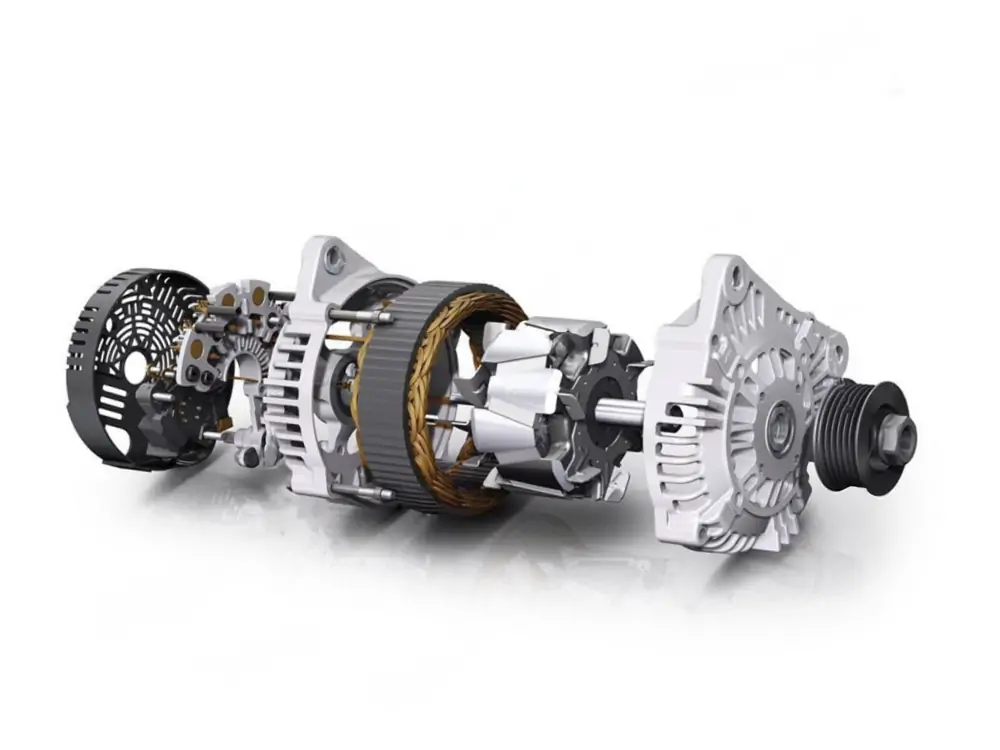
The parts and settings of the heavy-duty alternators are as follows:
Front Housing and Rear Housing
The alternative housing is constructed with aluminum alloy. Their function is to hold the components of the alternator. It serves three functions:
| Housing | Function |
| Front housing | The front housing provides the structural support.
The pulley attached to the crankshaft is connected to the mounting points here. The fan is positioned in the front housing. |
| Rare housing | The rare housing in the back protects the assembly of the slip rings, rectifier, and the brushers.
They provide mounting points for the rectifier and brushes. The rare housing features an excellent cooling ventilation system. |
Rotor
The rotating magnetic core is known as the rotor. It contains:
- A shaft
- Claw-pole field assemblies
- Field windings
- Slip rings
In a vehicle’s heavy-duty alternator, the process starts under excitation currents of 2 A to 5A, and the rotor generates a magnetic field. This magnetic field crosses this stator as it spins at 2,000 -10,000 RPM, creating AC voltage.
Stator
The stator is the stationary winding assembly. It typically operates 3-phase windings in a Y-connection, made of copper. Key features include:
- High-frequency-grade laminations
- Thermal insulation to 200 °C.
- High-current wire is heavy.
The rotating magnetic flux is transformed into an AC voltage by the stator. It helps produce 50V to 120V AC, rectified at high RPMs.
Rectifier
The rectifier uses 6–12 diodes; the number varies according to the design. It is tasked with transforming AC to DC. Heavy-duty rectifiers use:
- Diodes with high amperage of 100A and 150A
- Heat sinks for cooling.
- Electrostatic immunity to prevent spikes of voltage.
A rectifier failure may cause the alternator to produce no output or drain the battery.
Voltage Regulator
As the name indicates, it maintains the voltage in an alternator. It maintains the alternator system voltage at approximately 14.5V-14.8V. In the case of a heavy-duty alternator, this voltage range can reach 40V. The modern heavy-duty regulators provide:
- Temperature compensation
- Load response control
- Soft-start excitation
Brush/Brushless Design Compare and Contrast
| Brushed Alternators | Pros | Cons |
| Carbon-brushed alternators use carbon brushes to supply current to the rotor via slip rings.
|
Affordable
Simple design Easy to repair
|
The brush wears every 80,000–150,000 km.
Possible sparking More maintenance
|
| Brushless Alternators | ||
| The brushless systems are physically contactless.
|
Low maintenance
Higher efficiency Higher level of performance at high RPM.
|
Higher cost
More complex construction
|
Cooling System
The most significant concern of alternators is heat. Heavy-duty units use:
- Dual internal fans
- Larger ventilation windows
- High-speed airflow channels
- Some industrial models have external ducting.
An appropriate cooling system maintains the temperature below 120 °C, extending diode life and ensuring the output remains constant at the rated power.
Step-by-Step Working Process
| Steps | Working process |
| In the first step, the engine turns the pulley. | The crankshaft of the vehicle engine turns the alternator pulley at either a 2:1 or a 3:1 ratio. |
| After that, the rotor occupies the magnetic field. | At the next stage, the regulator applies 2-5A of current to windings on the rotor. The rotor is converted to an electromagnet. |
| In the third step, the rotor generates magnetic flux. | In a heavy-duty vehicle, an AC 3-phase voltage is produced by a varying magnetic field. The magnetic poles circulate across the windings of the stators as the rotor turns. |
| Fourth step, get started when a stator produces an AC Output. | The AC voltage in a heavy-duty alternator is between 30 V and 60 V. |
| AC to DC conversion. | The user must understand that AC waves are rectified by diodes, which allow current to flow in one direction, producing a smooth DC. |
| After that, the voltage regulator modifies production. | At voltages below 22V, this increases the rotor current. Any voltage that is above 24V reduces excitation.
The voltage regulator in a heavy-duty alternator can regulate the voltages from 75V to 260V. |
| In the vehicle, power is supplied by the batteries. | The DC output (typically 100A-500A) drives the battery and provides power to accessories. |
| The cooling system manages the heat during the process. | To keep the housing at safe temperatures, internal fans circulate air. |
Conclusion
When used in a vehicle, a heavy-duty alternator is required. It is a high-speed generator designed to be reliable and efficient. The user should realize that more refined windings, superior cooling, and higher-quality materials should be used. The heavy-duty alternators can withstand sustained high loads. They will operate on either a 40-60V electrical system to accomplish the same objective: providing a steady, reliable power supply for all electrical and electronic needs of heavy commercial machinery. They will have a structure and working process that will help diagnose faults, improve maintenance, and ensure a long service life.