
Introduction
Starting a car is not difficult, but many parts work together. One little part is very important when you turn the key. That is the starter solenoid, and most people never see it.
When it stops working, often the car will not even start, and it may not even tell you why. Knowing what it does can help identify a problem before it becomes more severe.
This article describes what it is, how it works, and when it fails.
What is a Starter Motor Solenoid?
A starter motor solenoid is an electric switch. It is part of the car’s overall starting system. Starting from the battery, it flows power to the starter motor.
By just a small signal, it can control a large load. This design saves the ignition from extreme current.
In today’s vehicles, the solenoid is directly attached to the starter motor. Earlier, it was attached somewhere else in the engine bay. No matter where it is placed, its purpose remains the same.
An engine can not turn over with a starter motor solenoid. This makes it a central piece of any vehicle.

How Starter Motor Solenoids Work
When you turn the key, energy from the battery passes through a small wire to the starter solenoid. Inside, a magnetic field is generated. The field forces a metal plunger forward. It draws two big electrical contacts together inside the starter solenoid.
Once closed, power from the battery goes directly to the starter motor. The motor rotates the engine, putting the crank in motion. When you free the key, the magnetic field goes away. The solenoid switches off the circuit, stopping power.
Components of a Starter Solenoid
A starter solenoid contains a few simple parts that function closely in conjunction with one another.
Inside it is a coil that produces a magnetic field when energized. The plunger is moved forward by the magnetic field.
Two large terminals carry the large current from the battery. One terminal is attached to the positive cable of the battery. The other connects directly with the starter motor. A smaller terminal has the signal from the ignition switch.
All these parts within the starter solenoid are essential to work fine together. Wear or damage to any part is a cause for starting problems.
Common fault symptoms of a starter solenoid
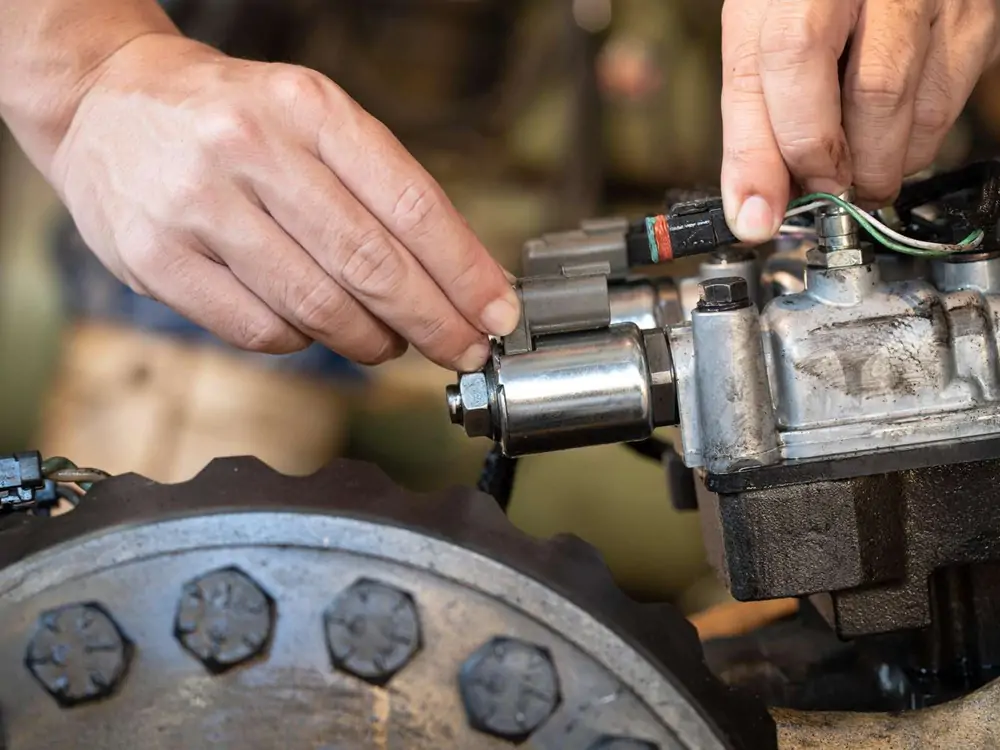
Before completely failing, a starter solenoid shows a few signs. These signs could be:
- A common sign is many clicks when you turn the key. It usually points to weak energy reaching the starter solenoid.
- Sometimes it is necessary to attempt some times before the engine eventually starts. This usually indicates that you are having a lot of worn contacts inside the starter solenoid.
- Another sign is no sound. This means that the engine does not start when you turn the key.
- A serious indication is a burning smell in the engine bay.
These are the warning signs that specify that the solenoid may need attention in the near future.
How to diagnose the bad starter solenoid?
Check the battery first if the starter solenoid is bad. A weak battery is sometimes the main cause of a bad starter solenoid. Measure its voltage with a multimeter, which should be around 12.6 volts.
Secondly, you should check wirings in the starter solenoid. It could be either loose, damaged, or rustier.
Thirdly, carefully listen for clicking sounds after turning the key. Only clicking without cranking could mean a failed solenoid.
Lastly, check for voltage in solenoid terminals. If there’s no power at the output terminal, it means your solenoid is faulty.
Conclusion
The starter motor solenoid may seem like a quiet part. But it is the most imperative part of any vehicle’s system. It is the part that starts your engine. It controls the flow of energy.
A starter motor solenoid usually gives signs before failing. If you ignore earlier small signs, it can lead to complete loss. Thus, a few checks can help you save time.
Once those high-current contacts close, battery current feeds the starter armature. Getting that current from the stationary housing onto the spinning rotor is the job of the brush-and-commutator assembly—a compact form of a slip ring path. The solenoid only switches the circuit in a straight line; the rotating contact keeps power on the shaft so the starter can crank without a break.
Learning about the starter solenoid can help you avoid panic in case of car trouble.